
Reader Comments Review: OBSESSION (aka “Bitches Be Crazy” The Movie)

Updated: May 24
I had very mixed feelings about OBSESSION.
While I genuinely think it’s effective as a horror film, it relies on a harmful underlying message: “bitches be crazy.”
Now to be clear, I don’t think the writer/director explicitly set out to make a misogynistic film. In fact, I think it’s quite the opposite.
Obsession clearly understands its actual thematic premise is toxic male control and entitlement over women.
The problem is that the film’s horror and humor rely on the familiar cultural assumption: a woman in love will inevitably become “crazy.”
In an interview, the director himself actually pinpoints the exact issue I had with the movie:

“'I wish this woman loved me more than anyone in the world.' What does it look like when a girl is just obsessed with a man?”
The film's answer to that is: she becomes psychotic.
This assumption is what the horror and humor of the film rely on.
What's really telling is that the director specifically directed Nikki to be played as: “a crazy, jealous girlfriend.”
And the key word in all of this is: "relatable."
The film isn’t treating Nikki’s behavior as purely supernatural or wildly out-there. The director explicitly wanted it to be “heightened, [but] relatable.”
And what makes it relatable?
The toxic yet common belief that women are crazy, especially when in love.
Even though the film’s intellectual point is that toxic male desire overrides women’s identities, the emotional engine of each scene is still: “look how insane this woman is!”
Again, I do not think the filmmaker accidentally missed the point of his own movie.
The film is fully aware that Bear is the true problem.
Bear doesn’t actually like Nikki as a person; he likes the idea of her. More specifically, the idea of being loved by her.
He wants her devotion without the cost of his own vulnerability, and control over how exactly she loves him (“Can I alter my wish?”).
That’s why the “real Nikki” moments are so important -- and frankly the strongest parts of the film.
Whenever Nikki briefly breaks through her obsessive side, the movie becomes much more interesting and genuinely terrifying, because the horror shifts away from “crazy woman behavior” toward something much darker: having no agency over your own body and behaviors.
In only these moments, Nikki is no longer being portrayed as a spectacle, but instead as a person tragically erased by someone else’s fantasy.
The problem is that those scenes are interruptions rather than the film’s main perspective.
When the focus is almost entirely on her insane behavior, the core thematic equation becomes: woman + love = crazy!
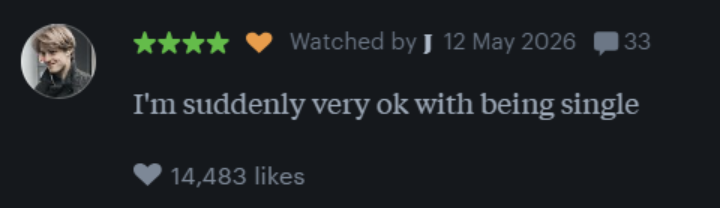
And that’s one of the main things some people seem to be taking away from the film (obviously these reviews aren't fully serious, but they're -- in Curry's own words -- "relatable" based on the common assumption that women in love are insane):



Interesting racial commentary here, but we won't be diving into that today. Just noting this harmful correlation between "crazy" and specifically Latina women. Maybe in another blog post I'll unpack this, along with other examples in media that play into this stereotype 🤔

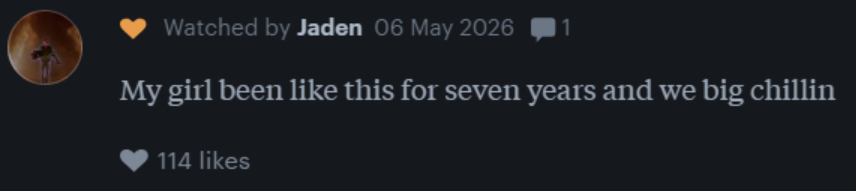





And of course:

But here’s what’s truly “crazy.”
This entire issue could have been solved with ONE word.
Instead of Bear's wish being: “I wish Nikki Freeman loved me more than anyone in the entire world,”
imagine if he said: “I wish Nikki were crazy in love with me.” or even simply “I wish Nikki were crazy about me.”
That changes the entire framing while still keeping Bear's wish intention intact.
The film’s actual wording implies that a woman’s love itself naturally becomes volatile and dangerous.
The second implies Bear specifically wished for something, well, crazy!
Which, in my opinion, only gives more weight to the film’s themes of “be careful what you wish for.”
Strengthening your theme and killing misogynistic framing in one fell swoop – Curry Barker, I’m available for rewrites on your next movie!
And that’s ultimately my issue with OBSESSION.
The movie clearly understands its true horror lies in men’s desire to control women, yet builds most of its emotional experience around the toxic yet culturally familiar idea: the scariest thing is a woman in love.
That all being said... here’s my official review of this movie:

Thank you for coming to my TED Talk.
Byeeeeeeeee!


Comments