
TOY STORY 5: How to Tell a Story, Not Show It

The central question of TOY STORY 5 seemed so promising:
What role do toys play in a world dominated by technology?
Yet the film spends most of its runtime asking the question: "How will this misplaced toy get back to where it belongs?"
Seriously, here's the entire plot:
Jessie and Bullseye are taken back home when Bonnie goes to a sleepover and is embarrassed to be seen with them. They need to find a way back to her, so...
They escape the car ride home, but are picked up by an elderly couple who returns them to Jessie's original owner's old address (written on Jessie's pants)
Bullseye is taken indoors by Blaze, the child of the home's new owners, and Jessie needs to go find him.
Meanwhile, Lily gets all of Bonnie's physical toys put in storage, and Buzz and Woody need to work together to save them.
Bonnie later rejects taking Jessie and Bullseye back from Blaze, so now they have to find another way home.
Then Lily kills herself -- I MEAN.... Puts herself in a donation bin (the toy equivalent of killing oneself). Now all the toys have to get her back!
Actually, now that I've written that all out, I actually think the central question is: "What does any of this have to do with the dangers of technology replacing physical toys?"`
For a movie that's supposedly about that, the plot's engine is consistently: toys accidentally ending up in the wrong place and needing to get back to the right place.
Which points to a larger flaw in the storytelling in this film:
TOY STORY 5 keeps telling us what it's about -- it rarely shows us.
When something is told to us in a story, we understand it intellectually. But in order to actually empathize with it, we need to experience it.
Let's talk about it!
Tell Me You Love Me!
When people hear "show don't tell," they usually think of exposition-heavy dialogue. Like having one character say to another: "I'm so glad we're best friends and spent all summer hanging out and having a blast!"
Which is exactly all the relationship-building we have to work with for Jessie and Bonnie, the central relationship of the film.

Early in the movie, Jessie tells us she spent all summer trying to help Bonnie make friends.
That's important information that helps us understand the context of their relationship.
But when it's just told to us, that's all it is: information. Not emotion, like it would be had we seen it play out on screen.
It's the storytelling equivalent of "you had to be there."
And relying on that for the relationship your entire film is built on leads to notes like these ones (which i furiously typed while watching the movie):
jessie says theyve been working to help Bonnie make friends but we dont actually see that. so her main goal / character arc doesn't quite land as something shes been working towards, or even something we should care about
the relationship between bonnie and jessie doesnt land because we dont see it really. we see the flashback to jessie's previous owner, then we see the wedding play scene from jessies pov. it does nothing to establish her bond with bonnie, so when jessie is fighting against lily for bonnie it doesnt land.
theyre trying to make us feel bad for this girl we have zero connection with. every emotional plot point in this movie is just a random scene theyre using to manipulate us into feeling something, rather than using the plot itself to make us feel something
Compare that to TOY STORY 1.
We don't need Woody to tell us Andy loves him -- we see evidence of it throughout the opening scenes.
Woody's place in Andy's life, and amongst the toys, is abundantly clear, so when Buzz enters the picture we understand exactly why he's a threat.
Every scene in the film builds on that tension, moving the plot forward.
In TOY STORY 5, the movie often skips straight to stating the conclusion ("physical toys are important," "Jessie and Bonnie have a close relationship," "tech is bad," etc.) and asks us to fill in the emotional part ourselves.
That's a lot to ask from your target audience of 4 - 10-year-olds.
So it's no surprise the kids in the theatre had 0 reaction to 99% of the movie. 😬
Tech is Bad! Or So I've Been Told...
The most unique aspect of this movie that sets it apart from other films in the franchise -- the technology angle -- is actually the least developed.
The film is trying to say that both physical toys and technology have a place in children's lives in the modern world.
It's a thoughtful message, but the film spends surprisingly little time showing us why.
Instead, it mostly tells us.
Jessie repeatedly blames technology for Bonnie drifting away from her toys -- even outright saying that the devices are useless.
But the tech toys are the only reason the og toys are able to do basically anything throughout the plot.
Snappy takes a photo of Jessie; Smarty uses the internet to upload that photo so Bonnie will see it.
Woody and Buzz exploit Lily's voice recognition to show Bonnie the photo, and Smarty communicates with her over text through Lily about where to find Jessie.
Atlas, Snappy, and Lily work together to track the donation truck.
Lily even distributes a firmware update that literally gives the Hi-Tech Buzzes the ability to fly.
Then, at the very end, Lily helps reunite Bonnie and Blaze.
At almost every major turning point, technology is what allows the story to move forward.
Which is a symptom of the larger issue: the movie never actually shows how technology itself is the problem. And even more importantly, it never shows us how / why physical toys are useful.
As far as tech:
The biggest obstacle Bonnie faces isn't her tablet -- it's the other kids.
She doesn't stop wanting to play with toys because Lily exists, she stops because the other girls make fun of her for it.
Technology didn't create the bullying, it just happened to be one of the mediums in which it occurred.
As far as the toys:
The the question I kept waiting for the movie to answer was: why is playing with physical toys beneficial?
In the first Toy Story, Buzz and Woody each have obvious strengths. The movie spends the entire runtime proving that they're both valuable.
TOY STORY 5 wants to arrive at a similar conclusion for physical toys and tech-based toys, but the screenplay only demonstrates half of that equation.
We see toys inspire imagination, but the movie never really explores why that imagination matters.
How does it help Bonnie?
How does it change her?
Why is imaginative play better than tech-based play?
The movie assumes we already know the answer.
And maybe a good amount of us do.
But strong storytelling doesn't assume the audience agrees with its conclusion -- it builds a thematic argument in a way that ideally persuades the audience to agree with the story's stance.
By the end of the film, I didn't necessarily disagree that physical toys are valuable (because irl i do understand they are!), but I wasn't convinced by the argument the film presented.
The Most Telling Moment
There was one moment towards the end of the film that actually SHOWS us how toys are important to kids in this world.
Jessie returns to the tree where Emily used to play with her and discovers a lunchbox buried beneath it. Inside is a photograph of Emily as an adult with her daughter... Who she named after Jessie.
This scene lasted all of about 45 seconds, yet it made me tear up like:
It was genuinely the only moment in the film that worked for me.
Why is that???
Because it showed its message rather than telling it.
Nobody stopped to explain why toys matter.
There were no speeches about the lifelong impact toys have on children.
The movie simply showed in a quick visual moment that Emily carried Jessie with her long after she stopped playing with toys.
Imagine if the entire movie committed to doing this.
Interestingly enough, shortly after this scene was the one scene in the movie that got a response from the kids in the audience.
It's when Bonnie and Blaze start playing together.
Using silly voices, exaggerated mannerisms, and making up crazy soap opera-esque storylines for their toys.
The kids were cracking up as soon as they heard / saw the goofy voices and mannerisms, and they laughed even more when we went into the toys' perspective as the melodrama played out.
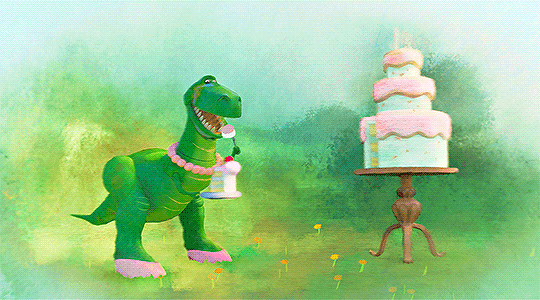
TOY STORY 5 spends nearly all of its runtime explaining why imagination matters... But its biggest audience reaction comes from a scene that simply demonstrates it.
If you saw TOY STORY 5, what did you think? Did it work for you? Why or why not?
Let me know in the comments!
See you next time......



I didn't watch yet the movie, but it will be now much more interesting to pay attention to what I'm actually getting out of it. The fact that my 10 years old nephew didn't say a word about the movie can tell me that t didn't really have a meaningful impact on her. Great review!